We helps manufacturers solve one of the most overlooked problems in packaging: getting thick products into containers accurately, cleanly, and consistently.
If you fill honey, gel, paste, cream, sauce, syrup, or other viscous products, the challenge is rarely just getting the product into the bottle or jar. The real problems start when the product is too thick to flow consistently, the nozzle keeps dripping, every container receives a slightly different quantity, or the machine slows down production.
And these small problems can become expensive.
Why Filling Thick Products Is Difficult
Thick products do not behave like water.
Honey can stretch from the nozzle.
Paste can resist flow.
Cream can trap air.
Gel can cling to filling components.
Sauces can change viscosity with temperature.
This is why a machine designed for low-viscosity liquids may not perform well with thick products.
The filling system has to match the product’s viscosity, filling volume, container, and production speed.
The Biggest Cost: Overfilling
Suppose your target is 500 g, but your machine consistently gives 505 g.
That extra 5 g may look insignificant.
At 10,000 containers, however, you have given away 50 kg of product.
For expensive products such as honey, creams, specialty sauces, or cosmetic formulations, filling accuracy directly affects your margins.
A good filling machine should therefore do more than fill quickly. It should deliver repeatable and controlled dosing.
Is Your Filling Machine Wasting Product?
Look closely at your production line.
Do you see:
- Product dripping after filling?
- Sticky containers?
- Product collecting around the nozzle?
- Frequent cleaning of conveyors?
- Product remaining inside the system?
- Operators manually correcting underfilled containers?
These are not merely housekeeping issues.
They can indicate that the filling system is not properly matched to the product.
Dripping Is More Than a Cleaning Problem
Thick liquids often continue moving after the filling cycle has stopped.
This creates stringing and dripping at the nozzle.
The result can be:
Product loss → dirty containers → more cleaning → slower production.
For retail products, there is another problem: presentation.
A clean, accurately filled jar looks professional. A jar with honey or sauce around its neck does not.
What About Changing Product Viscosity?
A product does not always have the same flow characteristics.
Temperature can make a major difference.
Honey, chocolate, creams, and some sauces may become easier to pump when warm and considerably thicker when cool.
That means a machine should be evaluated under real production conditions, not simply based on the product name.
Ask the supplier:
What happens to filling accuracy when my product viscosity changes?
That question can save you from an expensive mistake.
Filling Speed vs. Real Production Speed
A machine may advertise a high containers-per-minute figure.
But what happens when you increase the speed?
If higher speed causes:
- More splashing
- More dripping
- Inconsistent fills
- Air bubbles
- More rejected containers
then the machine may be running faster but your production is not necessarily becoming more efficient.
The better target is:
Maximum practical output with consistent filling accuracy.
Which Filling System Is Right for Thick Products?
There is no single filling technology that is best for every viscous product.
The choice depends on:
| Requirement | Why It Matters |
|---|---|
| Product viscosity | Determines how easily the product moves |
| Filling volume | Determines dosing requirements |
| Accuracy | Controls product giveaway |
| Container size | Affects nozzle and machine configuration |
| Production speed | Determines automation requirements |
| Product temperature | Can change flow behaviour |
| Particles | May affect pump and nozzle selection |
| Cleaning | Influences downtime and changeovers |
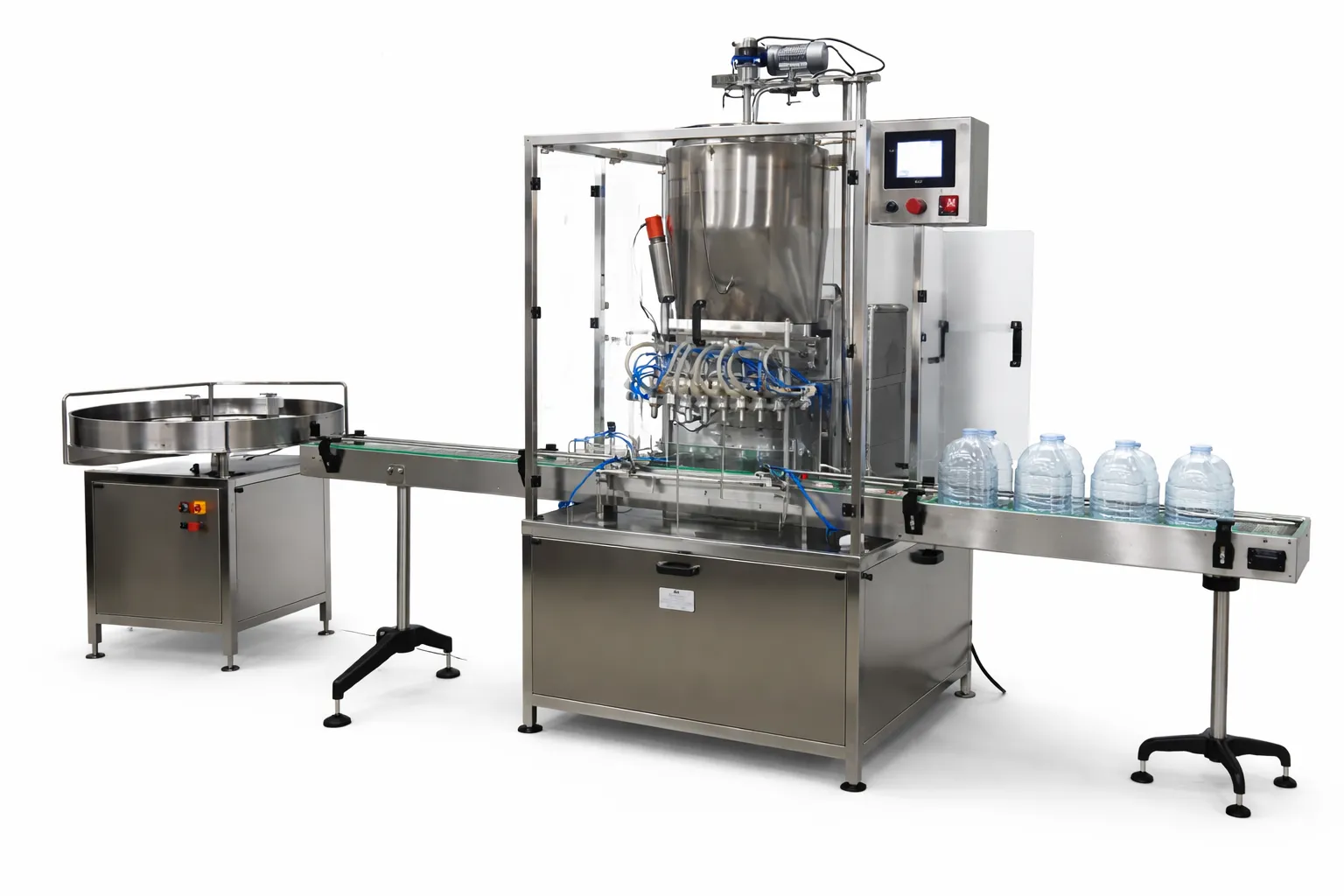
For many thick products, piston-based or pump-assisted filling systems can provide the controlled movement and dosing required. However, the correct configuration should be selected according to the actual product rather than assuming one system will suit everything.
Honey Filling: What Should You Look For?
Honey requires particular attention because of its viscosity and stickiness.
A suitable honey filling machine should provide:
- Consistent dosing
- Controlled product flow
- Clean nozzle operation
- Adjustable filling volume
- Suitable handling of viscous product
- Easy cleaning
The objective is not simply to fill honey into jars.
It is to fill every jar to the required quantity without unnecessary product loss.
What About Gel, Cream and Paste?
The same principle applies to gels, creams, cosmetic products, tomato paste, fruit paste, mayonnaise, and thick sauces.
But there is an important difference:
Two products with the same viscosity may still require different filling solutions.
Particle size, temperature, formulation, air content, and desired filling speed can all influence machine selection.
That is why product testing is often more valuable than choosing a machine from a catalogue based on a single specification.
Automatic or Semi-Automatic?
Your production volume should guide the level of automation.
Semi-Automatic
Suitable when production volumes are moderate and operators are available for container placement and handling.
Automatic
More suitable when production requires higher throughput and consistent operation with reduced manual intervention.
The question should not simply be:
“Which machine is more advanced?”
Instead ask:
“Which level of automation makes economic sense for my production volume?”
Don’t Buy Based on Price Alone
The purchase price is only one part of the cost.
Consider the total operating cost:
Machine price + product wastage + labour + cleaning time + maintenance + downtime.
A cheaper machine that wastes product every day may eventually cost more than a higher-quality system that provides consistent filling.
This is particularly important for high-value products.
Questions to Ask Before Buying
Before selecting a filling machine for honey, gel, paste, or thick liquids, give the manufacturer accurate information about your application.
Ask:
- What is the viscosity of my product?
- What is the product temperature during filling?
- What filling accuracy can I realistically expect?
- How does the machine handle dripping and stringing?
- What filling volumes can it handle?
- What production speed is achievable with my actual product?
- How easy is cleaning and changeover?
- Can the machine handle different container sizes?
- Can the system be expanded if production increases?
- Can my product be tested before I purchase?
That final question is particularly important.
A machine that works perfectly for one thick product may not work the same way for another.
The Right Machine Solves the Right Problem
If your biggest problem is product giveaway, prioritize accuracy.
If your problem is slow production, look at automation and cycle time.
If your problem is dripping, focus on nozzle and filling-system design.
If your problem is frequent cleaning, examine product-contact design and changeover requirements.
If your problem is inconsistent filling, investigate viscosity, dosing technology, and product flow.
The best filling machine is therefore not simply the machine with the highest speed or lowest price.
It is the machine that addresses your specific production problem.
Choose a Filling Machine That Works for Your Product
For honey, gel, paste, cream, sauce, and other thick liquids, the right filling machine is not simply the one with the highest speed or lowest price. It is the one that gives you consistent filling, controlled product flow, less wastage, cleaner operation, and reliable production.
Before investing, evaluate the actual product, viscosity, filling volume, container, production target, and cleaning requirements.
We provides filling solutions designed around these practical requirements, helping manufacturers choose equipment that fits their product and production process.
The right question is not “Which filling machine is cheapest?”
It is:
“Which filling machine will give me the lowest cost per accurately filled container?”